


How to Choose a Hormone Specialist in Albuquerque (Questions to Ask)
The right hormone specialist in Albuquerque will listen to your full story, test before treating, explain every option (including the risks and the alternatives), and monitor you closely once you start. Before you commit, ask about their hormone training, which labs they order, how they choose a delivery method, how often they recheck your levels and what the full cost looks like over a year. If a clinic can’t answer those questions clearly, keep looking.
If you’re dealing with hot flashes, stubborn fatigue, brain fog, a disappearing sex drive or the feeling that you just aren’t yourself anymore, finding help can feel like its own part-time job. You search for hormone replacement therapy in Albuquerque, and you get a wall of clinics, pellet ads and promises. Some sound too good to be true. Others make you wonder whether anyone will actually take the time to listen.
This guide is here to help you sort through it. It covers which kinds of providers treat hormones, what a good first visit looks like, the questions worth asking before you book, the red flags to watch for and how cost and insurance usually work. You’ll be able to choose with confidence, whether you end up with us or somewhere else.
From Jalayne: “I often see patients for hormone consultations who have been told by their doctor or another provider that their labs look normal, but they still know something isn’t right. It’s that brain fog, that lack of energy they feel on a daily basis. Because our approach at Foundation is to take the time to listen to every patient and understand what they’re experiencing, we can offer solutions to that ‘off’ feeling.”
What Does a Hormone Specialist Actually Do?
“Hormone specialist” isn’t a single license or board certification. It’s a description of what a provider focuses on. In practice, several kinds of clinicians treat hormone concerns, and each one tends to approach them differently.
A good hormone provider looks at the whole system: estrogen, progesterone and testosterone, along with thyroid function, metabolic health, sleep, stress and nutrition. These systems talk to each other. Low energy, for example, can come from low testosterone, an underactive thyroid, iron deficiency, poor sleep or all of the above. The job isn’t just to prescribe a hormone. It’s to figure out why you feel the way you do and then build a plan that fits your body, your health history and your goals.
Here’s how the most common types of hormone providers compare:
| Provider type | What they typically focus on | Good fit if you… | Keep in mind |
|---|---|---|---|
| Endocrinologist (MD/DO) | Diagnosing and treating endocrine disease: diabetes, thyroid disorders, pituitary and adrenal conditions | Have a complex or rare endocrine condition | Often requires a referral and long wait times. Many focus on disease management more than menopause or symptom-driven care |
| OB-GYN or menopause practitioner | Women’s reproductive health, perimenopause and menopause | Want menopause care alongside gynecologic care | Approaches to hormone therapy vary widely from one practitioner to the next |
| Urologist | Men’s urologic and sexual health, including low testosterone and ED | Have urologic symptoms or prostate concerns | Usually focused on men only |
| Nurse practitioner–led hormone or wellness practice | Symptom-driven hormone therapy for men and women, often alongside metabolic, weight and primary care | Want longer visits, a whole-person approach and direct access to your provider | Training and quality vary, so ask the questions below |
| Primary care provider | Overall health, screening, chronic conditions | Want your hormone care coordinated with everything else | Some offer hormone therapy; many refer it out |
There’s no single “best” type. The best hormone specialist in Albuquerque for you depends on what’s going on, how complex your history is and how much time and partnership you want from your care.
Can a Nurse Practitioner Be Your Hormone Specialist in New Mexico?
Yes. New Mexico is one of the states that gives certified nurse practitioners (CNPs) full practice authority. That means a licensed CNP can evaluate, diagnose, order labs and prescribe independently, including hormone therapy, without a supervising physician. Prescriptive authority is granted through the >New Mexico Board of Nursing, with controlled-substance authority (testosterone is a Schedule III controlled substance) also registered with the New Mexico Board of Pharmacy and the DEA.
A license is only the starting point, though. Whether your provider is an MD, DO, PA or NP, what matters most is their specific training and experience in hormone care, how often they treat patients like you and how carefully they monitor. That’s why the first question on our list below asks about training and experience, not just the letters after a name.
From Jalayne: “At Foundation, our certifications include the MEP-C (Medical Esthetics Practitioner Certification) for both myself and Noelle Maez-Barress, MSN, RN-BC, our aesthetic nurse injector. This is a national certification in aesthetic medicine. I’ve also been selected to present at the New Mexico Nurse Practitioner Council conference in April 2027 on hypercortisolism and appropriate hormone testing. I’m excited to share the results we’ve seen and to continue learning from others in the field.”
What Questions Should You Ask a Hormone Specialist Before You Book?
This is the heart of the guide. Bring these questions to a consultation (or a phone call with the front desk) and pay attention to how they’re answered, not only what is said. A confident, unhurried provider will welcome them.
10 Questions to Ask a Hormone Specialist
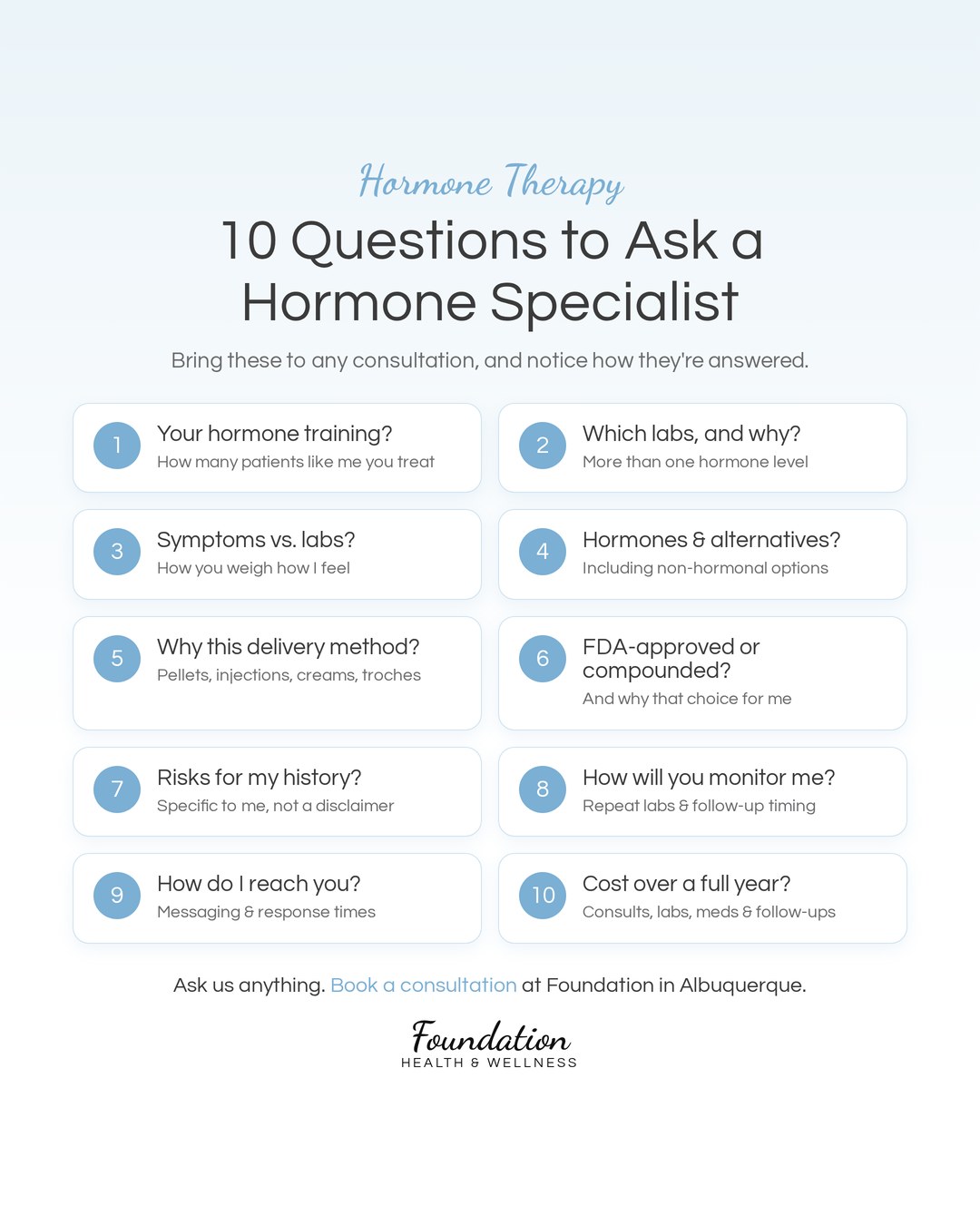
- What training and experience do you have in hormone therapy? Ask how many patients like you they treat and whether they care for both men and women.
- What labs will you order before treatment, and why? Expect more than a single hormone level. Thyroid, metabolic markers and a blood count are common, depending on your symptoms.
- How do you weigh my symptoms against my lab results? “Your labs are normal” shouldn’t end the conversation, and one number shouldn’t be the whole plan either.
- Which hormones are you recommending, and what are the alternatives? That includes non-hormonal options and lifestyle changes.
- Why this delivery method for me? Pellets, injections, creams, troches and patches each have trade-offs.
- Is this an FDA-approved product or a compounded one? Both can have a place, and you deserve to know which you’re getting and why.
- What are the risks for someone with my health history? A good answer is specific to you, not a disclaimer.
- How will you monitor me, and how often? Ask when repeat labs happen and what happens if something is off.
- How do I reach you between visits? Ask whether you can message the provider directly and how quickly you’ll hear back.
- What will this cost over a full year? That includes consults, labs, medication, procedures and follow-ups, not just the first month.
Let’s look at why a few of these matter so much.
Labs and symptoms (questions 2 and 3). Hormones fluctuate, especially during perimenopause, and a single “normal” result doesn’t always explain how you feel. On the other hand, treatment should never be based on symptoms alone with no testing at all. For men, the Endocrine Society recommends diagnosing low testosterone only when symptoms are present and low levels are confirmed with repeat morning blood tests (>Endocrine Society). If you’ve been told everything looks fine but you still feel awful, our article on why your labs can be “normal” when you don’t feel normal goes deeper.
Delivery method (question 5). There’s no single best way to take hormones. Pellets offer convenience but can’t be adjusted once placed. Injections are precise and affordable but require a schedule. Creams are flexible but take daily consistency. We compare them side by side in Hormone Pellets vs. Injections vs. Creams.
FDA-approved vs. compounded (question 6). “Bioidentical” describes hormones that are chemically identical to the ones your body makes. Some bioidentical products are FDA-approved; others are compounded by a pharmacy for an individual patient. The FDA notes that compounded drugs are not FDA-approved, so the agency doesn’t review their safety, effectiveness or quality before they’re sold (>FDA). Compounding can meet a real individual need, such as a dose or combination that isn’t commercially available. A trustworthy hormone specialist will explain which type they’re recommending and why, instead of claiming one is “natural” and therefore risk-free.
What Should Happen at Your First Hormone Therapy Appointment?
Your first visit sets the tone for everything that follows. Whether you’re looking for HRT in Albuquerque for menopause symptoms or exploring testosterone therapy, a thorough first appointment usually includes:
- A real conversation. Your symptoms, when they started, how they affect your sleep, mood, energy, relationships and work, and what you want to feel like again.
- A full health history. Personal and family history of blood clots, stroke, heart disease, breast or prostate cancer and liver disease, plus your current medications and supplements.
- Testing. Labs appropriate to the hormones being considered, and often thyroid and metabolic markers too. Some clinics draw labs before the first visit so results are ready to discuss.
- An honest discussion of options. That includes benefits, risks, alternatives and what the evidence says.
- A plan with check-ins built in. You should leave knowing when your next labs are, when you’ll follow up and how to reach the office with questions.
It also helps to know the current evidence. The Menopause Society’s position statement concludes that for most healthy women with symptoms who are under 60 or within 10 years of menopause, the benefits of hormone therapy outweigh the risks (>The Menopause Society). In November 2025, the FDA announced it was removing the boxed “black box” warnings from menopausal hormone therapy labels, which had discouraged many women from considering treatment for more than two decades (>FDA). That doesn’t mean hormone therapy is right for everyone. Risks still depend on your age, your health history, the type of hormone and how it’s delivered. It does mean you deserve a provider who’s up to date and willing to have a nuanced conversation.
If menopause is your main concern, our menopause care page walks through common symptoms and how we test for them.
What Are the Red Flags When Choosing a Hormone Clinic?
Most providers offering HRT in Albuquerque want to help. Still, it’s worth knowing the warning signs. Be cautious if a clinic:
- Promises specific results. No one can guarantee you’ll lose a certain amount of weight, sleep through the night or “feel 25 again.” Bodies respond differently.
- Uses one protocol for everyone. If every patient gets the same pellet dose or the same package, your individual history isn’t driving the plan.
- Skips testing or skips follow-up labs. Starting without baseline labs, or never rechecking after you start, removes the guardrails that keep treatment safe.
- Won’t tell you who’s treating you. You should know the name and credentials of the person prescribing your hormones and be able to look them up.
- Pressures you into a long contract or prepaying. A good provider earns your trust over time.
- Brushes off your questions about risks. Every treatment has trade-offs. A provider who says “there are no side effects” isn’t giving you the full picture.
- Hides the price. You should be able to get a clear estimate of the full cost before you start.
How Much Does Hormone Therapy Cost in Albuquerque, and Does Insurance Cover It?
The cost of hormone therapy in Albuquerque depends on which hormones you need, how they’re delivered, how often you’re seen and which labs you need. As a broad national guide, pellet insertions often run a few hundred dollars every three to six months, while injections and creams are typically billed monthly. Our pellets vs. injections vs. creams article breaks down typical cash-pay ranges by delivery method.
Insurance coverage for hormone therapy varies widely. Some plans cover certain FDA-approved hormones and basic labs, but many don’t cover compounded hormones, pellet insertion or the longer visits that symptom-driven care requires. That’s one reason many practices offering hormone replacement therapy in Albuquerque, including ours, are self-pay. At Foundation, there are no referrals or prior authorizations needed, pricing is shared up front, and many services can be paid with HSA or FSA funds. We’re happy to provide itemized receipts for you to submit.
When you compare clinics for HRT in Albuquerque, compare the annual cost, not the first-month price. Ask:
- Is the consultation fee applied to treatment?
- Are labs included or billed separately?
- How many follow-up visits are included?
- Are there procedure, supply or membership fees?
Hormone therapy pricing at Foundation (as of October 2026)
- Initial HRT consultation: $175–$225
- Hormone pellets: $399 for women, $799 for men (per insertion)
- Testosterone injections for men: $450 per quarter
Pricing is self-pay and subject to change. Your provider will confirm the costs for your specific plan before you start.
How Does Foundation Health & Wellness Approach Hormone Care?
We built Foundation Health & Wellness for people who are tired of feeling rushed, unheard and told their symptoms are “just part of getting older.” Here’s what hormone therapy in Albuquerque looks like with us:
- Care led by an experienced provider. Your hormone care is led by Jalayne Faulhaber, CNP, who brings more than 20 years of experience across emergency, urgent, primary and concierge care.
- Testing comes first. We evaluate estrogen, progesterone, testosterone and thyroid levels, along with other markers based on your symptoms, before recommending a plan.
- Care for women and men. We help women through perimenopause and menopause and help men with symptoms of low testosterone.
- Several delivery options. We offer bioidentical hormone therapy as topical creams and troches, EvexiPEL® hormone pellets and testosterone injections. We help you choose the option that fits your body and your life.
- Whole-person support. That includes nutrition guidance, stress and adrenal support, and thyroid and metabolic care, because hormones don’t work in isolation.
- Self-pay with no surprises. There are no referrals, no prior authorizations and no surprise bills.
Learn more about hormone replacement therapy in Albuquerque on our HRT service page. If you’re weighing local options side by side, our 2026 comparison of Albuquerque weight loss and hormone providers lays out the facts using each provider’s own public information.
From Jalayne: “Typical follow-up includes labs and testing to determine physiological response, but also genuinely sitting down and discussing how the patient is feeling. We want to see the symptoms they came in with, whether that’s trouble sleeping, irritability or anything else, start to normalize a bit.”
Frequently Asked Questions
Do I need a referral to see a hormone specialist in Albuquerque?
It depends on the practice and your insurance. Many insurance-based specialists, like endocrinologists, require a referral. At Foundation Health & Wellness, no referral is needed. You can book directly.
What’s the difference between an endocrinologist and a hormone therapy clinic?
Endocrinologists are physicians who specialize in diagnosing and treating endocrine diseases such as diabetes and thyroid or pituitary disorders. Hormone therapy clinics typically focus on symptom-driven care for menopause, perimenopause and low testosterone, often with longer visits and more frequent follow-up.
What labs should be done before starting hormone replacement therapy?
It depends on your symptoms and the hormones being considered. Common labs include estradiol, progesterone, testosterone, thyroid markers, a complete blood count and metabolic markers. For men, guidelines recommend confirming low testosterone with repeat morning tests.
How long does it take to feel a difference on hormone therapy?
It varies by person, hormone and delivery method. Some people notice changes in sleep or hot flashes within a few weeks, while other benefits can take a few months. Your provider should recheck your labs and symptoms and adjust your plan as needed.
Is bioidentical hormone therapy safer than traditional hormone therapy?
Not automatically. “Bioidentical” describes the hormone’s structure, not its safety. Some bioidentical hormones are FDA-approved and others are compounded. Your provider should explain the options, the evidence and the risks for your specific health history.
Can men see a hormone specialist for low testosterone?
Yes. Symptoms like low energy, reduced libido, loss of muscle mass, brain fog and poor sleep can be related to low testosterone, though they have other possible causes too. A hormone specialist should confirm low levels with proper testing before recommending treatment.
Feel Like Yourself Again, With a Provider Who Listens
Choosing a hormone specialist is a big decision. You deserve a provider who takes the time to understand what’s going on, explains your options clearly and stays with you every step of the way. If you’re looking for hormone therapy in Albuquerque that starts with listening, we’d love to meet you.
>Book your hormone consultation today or call us at (505) 275-4770.
Foundation Health & Wellness · 4550 Eubank Blvd NE, Suite 105, Albuquerque, NM 87111
This article is for general education and isn’t a substitute for personal medical advice. Talk with a qualified healthcare provider about the risks and benefits of any treatment for your specific situation.