


Hormone Testing for Women: What Your Labs Can (and Can’t) Tell You
Hormone testing for women can show where your estrogen, progesterone, testosterone, thyroid and related markers stand, rule out other causes of your symptoms and give your provider a baseline for safe treatment. What it can’t do on its own is tell you how you feel or “diagnose” perimenopause from a single number. Hormones shift by the hour and across your cycle, so the most useful results come from the right tests, taken at the right time and read alongside your symptoms.
Maybe you’ve been sleeping poorly for months. Your periods are changing, your energy is gone by mid-afternoon, and your patience is shorter than it used to be. You ask for a hormone test, hoping for an answer, and you hear one of two things: “We don’t really test for that,” or “Your labs are normal.”
Both answers can leave you feeling dismissed. Neither one tells the whole story. This guide explains what female hormone testing actually measures, which tests are worth asking for, why timing matters so much and how to make sense of results that don’t match the way you feel. Our goal is for you to walk into your next appointment informed and walk out with a plan.
What Does a Hormone Test for Women Actually Measure?
A hormone test measures how much of a specific hormone is in your blood (or, less often, your saliva or urine) at the moment the sample is taken. That last part matters. A hormone level is a snapshot, not a movie.
Most women’s hormone panels look at three groups of markers:
- Reproductive hormones. These are estradiol (the main form of estrogen before menopause), progesterone, testosterone, and the brain signals that control them, FSH (follicle-stimulating hormone) and LH (luteinizing hormone).
- Hormones that affect how you feel every day. Thyroid hormones, cortisol (your main stress hormone) and DHEA-S all influence energy, weight, mood and sleep, and their symptoms often overlap with perimenopause.
- Supporting markers. SHBG (sex hormone-binding globulin) shows how much testosterone is actually available to your body. Iron, vitamin D, B12, blood sugar and cholesterol markers help rule out other causes of fatigue, brain fog and weight change.
On their own, any one of these numbers says very little. Together, and next to your symptoms, they start to tell a story.
Which Hormone Tests Should Women Ask For?
There’s no single “complete” women’s hormone panel that’s right for everyone. The best tests depend on your age, your cycle, your symptoms and your goals. Still, a thorough evaluation for hormone-related symptoms commonly includes:
| Test | What it tells you | When it’s most useful |
|---|---|---|
| Estradiol | Your main estrogen level | Irregular cycles, hot flashes, vaginal dryness, before and during hormone therapy |
| Progesterone | Whether you ovulated that cycle | Cycle changes, sleep and mood symptoms, before and during hormone therapy |
| FSH and LH | How hard your brain is signaling your ovaries | Irregular or missed periods, possible early menopause |
| Total and free testosterone, plus SHBG | Available testosterone | Low desire, low energy, before considering testosterone therapy |
| TSH, free T4 (and sometimes thyroid antibodies) | Thyroid function | Fatigue, weight change, hair thinning, feeling cold, mood changes |
| Cortisol | Stress hormone output and rhythm | Fatigue, sleep problems, weight gain around the middle, suspected cortisol excess |
| DHEA-S | Adrenal hormone production | Low energy, low libido, acne or excess hair growth |
| Prolactin | A pituitary hormone that can affect cycles | Missed periods, unexpected nipple discharge |
| CBC, ferritin, vitamin D, B12 | Anemia and common deficiencies | Fatigue, brain fog, hair loss |
| Metabolic markers (A1c, fasting glucose or insulin, lipids) | Blood sugar and heart health | Weight gain, cravings, before starting hormone therapy |
Thyroid testing deserves a special mention. An underactive thyroid can cause fatigue, weight gain, low mood and heavy or irregular periods, so it can look a lot like perimenopause. The >American Thyroid Association notes that TSH is usually the best first test of thyroid function, with free T4 added for a fuller picture.
At Foundation Health & Wellness, a hormone evaluation typically looks at estrogen, progesterone, testosterone and thyroid levels, along with nutrient deficiencies that can make symptoms worse. You can read more on our menopause care page.
When Should You Get Your Hormones Tested?
Timing is one of the most overlooked parts of hormone testing for women, and it’s often why results seem confusing.
- If you still have periods, your levels change throughout your cycle. FSH and estradiol are often checked early in the cycle (around days 2 to 5). Progesterone is usually checked about a week before your next expected period, when it should be at its peak if you ovulated (>MedlinePlus).
- If your cycles are irregular or have stopped, your provider may test on any day and repeat the test to look for a pattern.
- Testosterone and cortisol follow a daily rhythm and are usually highest in the morning, so morning blood draws are common.
- If you’re on hormone therapy, testing is timed around your dose. For pellets, creams or injections, your provider will tell you when to come in, because a level taken at the wrong point can look falsely high or low.
A few other things can skew your results. Tell your provider if you take hormonal birth control, because it suppresses your natural cycle and changes several hormone levels. High-dose biotin, which is common in hair, skin and nail supplements, can interfere with many lab tests, including thyroid and reproductive hormone tests (>FDA). Ask your provider before you stop any supplement or medication.
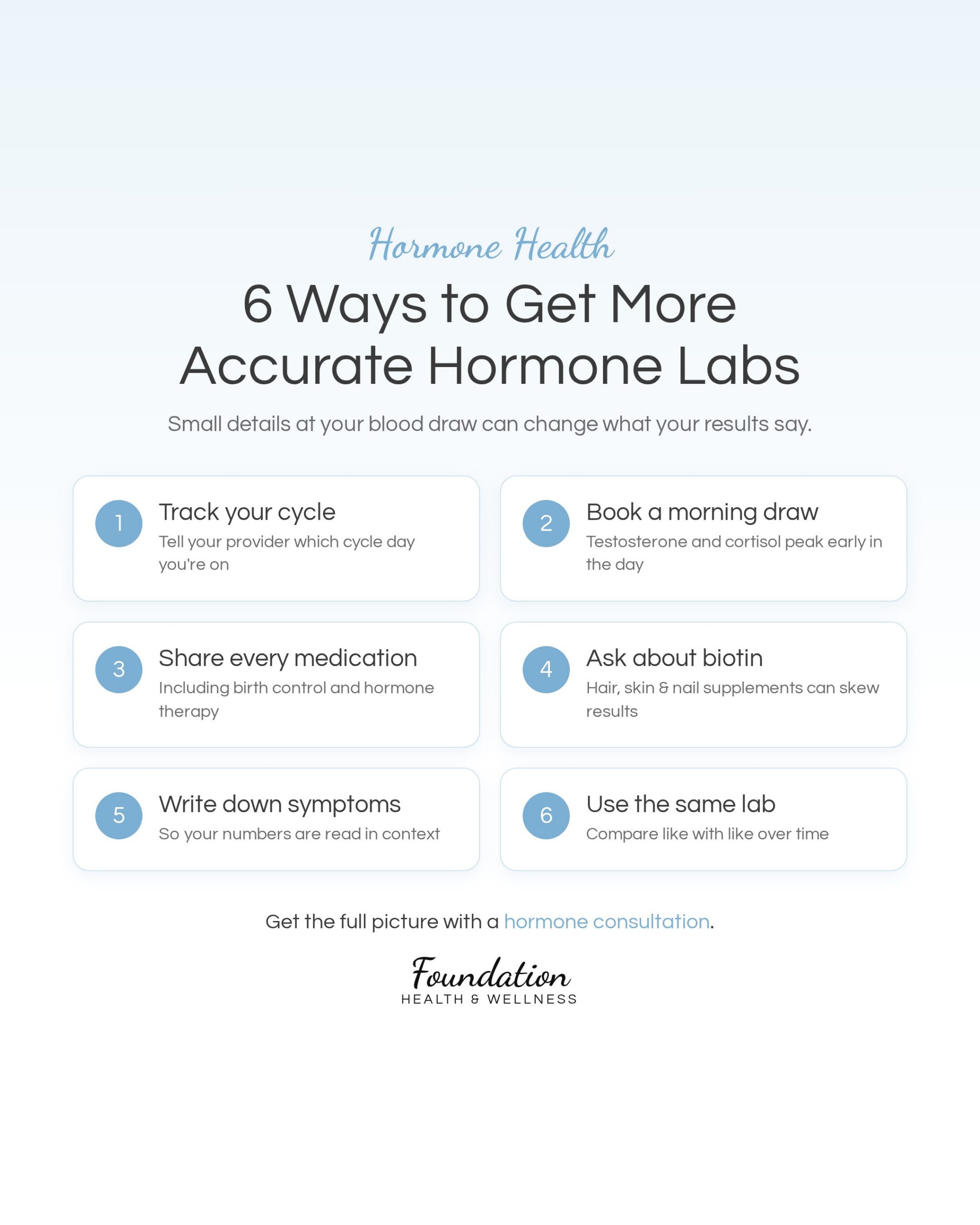
6 Ways to Get More Accurate Hormone Labs
- Track your cycle and tell your provider which day of your cycle you’re on.
- Book a morning draw when testosterone or cortisol is being checked.
- Share every medication and supplement, including birth control and hormone therapy.
- Ask about biotin before your draw, since it can skew results.
- Write down your symptoms so your results can be read in context.
- Use the same lab over time so you’re comparing like with like.
Can a Hormone Test Diagnose Perimenopause or Menopause?
Usually not by itself, and this surprises a lot of women.
During perimenopause, FSH and estradiol can swing from high to low and back again, sometimes within days. One “normal” result doesn’t rule perimenopause out, and one high result doesn’t confirm it. That’s why major guidelines diagnose perimenopause and menopause mainly from your age, your cycle changes and your symptoms. For example, the UK’s National Institute for Health and Care Excellence (>NICE) advises against relying on an FSH test to diagnose perimenopause or menopause in women over 45. >ACOG similarly describes menopause as confirmed after 12 months without a period.
So why test at all? Because hormone testing for women still does several important jobs:
- It rules out look-alikes, such as thyroid disease, anemia, high prolactin or blood sugar problems, that need different treatment.
- It helps when the picture is unclear, such as for women under 45 with cycle changes, women who’ve had a hysterectomy or women using hormonal birth control.
- It creates a baseline before hormone therapy, so your provider can monitor your response safely.
- It guides dosing of some therapies, especially testosterone and pellets.
What Your Hormone Labs Can’t Tell You
Female hormone testing is a powerful tool, but it has real limits. Knowing them can save you a lot of frustration.
A “normal” result isn’t always optimal for you. Reference ranges are built from population averages and are very wide. Two women can both be “in range” and feel completely different. We wrote more about this in Why Your Provider Says “Your Labs Are Normal” – But You Still Feel Awful.
One test is a snapshot. Hormones rise and fall with your cycle, the time of day, sleep, stress and illness. Trends over time are often more meaningful than a single value.
There’s no testosterone number that diagnoses low libido. An international consensus of medical societies found that blood testosterone levels don’t reliably predict sexual desire in women. Testosterone is measured to establish a baseline and keep treatment in a safe range, not to diagnose low desire on its own (>Global Consensus Position Statement, 2019).
Labs don’t measure how you feel. Hot flashes, sleep, mood, energy, libido and brain fog are things only you can report. A good provider treats your symptoms as data, too.
Blood, Saliva or Urine: Which Hormone Test Is Best?
You’ve probably seen ads for at-home saliva kits and “complete” urine panels. Here’s how the main options compare:
| Test type | What it’s good for | Limitations |
|---|---|---|
| Blood (serum) | The standard for estradiol, progesterone, testosterone, FSH, LH, thyroid and most other hormones. Used in clinical guidelines and research | A single draw is a snapshot, so timing matters |
| Saliva | Late-night salivary cortisol is a validated test when cortisol excess is suspected | Levels of sex hormones vary widely and aren’t considered a reliable guide for hormone therapy, especially with creams or troches |
| Dried urine | Shows hormone metabolites and daily cortisol patterns | Not standardized for diagnosing or dosing hormone therapy in mainstream guidelines, and it’s often costly |
| At-home finger-prick kits | Convenient screening | Limited panels, and results still need a provider to interpret them and act on them |
For most women, a blood panel ordered and interpreted by a provider who also listens to your symptoms is the most reliable place to start. The Menopause Society’s position statement on hormone therapy notes that salivary hormone levels aren’t a reliable way to guide treatment (>The Menopause Society, 2022).
Should Cortisol Be Part of Hormone Testing?
Sometimes. Cortisol affects sleep, blood sugar, weight, mood and energy, and chronic stress can leave many women feeling “wired and tired.” But cortisol testing needs to be done thoughtfully, because one random level means very little.
When a provider is concerned about true cortisol excess (hypercortisolism), the Endocrine Society recommends specific tests, such as a late-night salivary cortisol, a 24-hour urine cortisol or an overnight dexamethasone suppression test (>Endocrine Society, 2008). Picking the right test, at the right time, is what makes the result worth having.
From Jalayne: “I’ve been selected to present at the New Mexico Nurse Practitioner Council conference in April 2027 on hypercortisolism and appropriate hormone testing. I’m excited to share the results we’ve seen and to continue learning from others in the field.”
What Happens After Your Hormone Results Come Back?
Results should start a conversation, not end one. A thoughtful follow-up visit usually includes:
- A walk-through of every number, what it means and how it connects to your symptoms
- A look at the whole picture, including sleep, stress, nutrition, medications and health history
- A clear plan. That might be lifestyle and nutrition changes, treating a thyroid or iron issue, bioidentical hormone therapy, or simply retesting at a better time
- A monitoring schedule if you start treatment, so your plan can be adjusted based on both your labs and how you feel
From Jalayne: “Typical follow-up includes labs and testing to determine physiological response, but also genuinely sitting down and discussing how the patient is feeling. We want to see the symptoms they came in with, whether that’s trouble sleeping, irritability or anything else, start to normalize a bit.”
If you’re weighing hormone therapy, it also helps to understand your delivery options. Read The Best Hormone Therapy: Hormone Pellets vs. Injections vs. Creams, or see our guide on how to choose a hormone specialist in Albuquerque.
Get Answers That Fit How You Actually Feel
You know your body. If something feels off, you deserve more than a quick “your labs are normal.” You deserve the right tests, read in the context of your life, and a provider who takes the time to explain them.
At Foundation Health & Wellness in Albuquerque, we combine comprehensive female hormone testing with unhurried visits and a plan built around your goals. >Book your hormone consultation and take the first step toward feeling like yourself again. Confidence begins with care.
Frequently Asked Questions
What is the best hormone test for women?
For most hormones, a blood test ordered by a provider is the most reliable option. The right panel depends on your symptoms and life stage, and it usually includes estradiol, progesterone, testosterone, thyroid markers and supporting labs.
When is the best time to test female hormones?
If you have regular periods, many hormones are checked early in your cycle, and progesterone is checked about a week before your next period. Testosterone and cortisol are usually checked in the morning. Your provider will tell you the best timing for your situation.
Can a blood test confirm perimenopause?
Not on its own. Hormone levels swing widely during perimenopause, so diagnosis is based mainly on age, cycle changes and symptoms. Testing is still useful to rule out other causes and to set a baseline before treatment.
Why do I feel awful if my hormone levels are normal?
Reference ranges are wide, a single test is a snapshot, and other issues, such as thyroid function, iron, sleep or stress, can cause similar symptoms. A provider should interpret your results alongside how you feel.
Are at-home hormone tests accurate?
Some can provide useful screening information, but saliva testing for sex hormones isn’t considered reliable for guiding treatment, and any at-home result still needs a provider to interpret it.
Do I need a referral for hormone testing at Foundation?
No. You can book a hormone consultation directly online, with no referral needed.
This article is for educational purposes and isn’t a substitute for personalized medical advice. Talk with a qualified healthcare provider about your symptoms, testing and treatment options.