


What Is Direct Primary Care? How Flat-Fee Care Works in Albuquerque
Direct primary care (DPC) is a membership model where you pay your primary care provider a flat monthly fee instead of billing insurance for each visit. That fee typically covers most everyday primary care, like unhurried appointments, direct messaging with your provider and help managing ongoing health concerns. Because there’s no insurance company in the middle, visits can be longer, easier to schedule and focused on what you actually need.
If you’ve ever waited three weeks for a 10-minute appointment, only to feel rushed out the door before you asked your second question, you already understand why direct primary care in Albuquerque is growing. It isn’t a luxury reserved for a few. It’s a different way of paying for care, built so that you and your provider can focus on your health instead of codes, copays and claim denials.
This guide explains how flat-fee primary care works and how it compares to concierge medicine and traditional insurance-based care. It also covers what a membership usually includes (and doesn’t), who it’s a good fit for, and what to ask before you join any practice, including ours.
At Foundation Health & Wellness, care is led by Jalayne Faulhaber, CNP, who brings more than 20 years of emergency care experience, plus years in urgent and primary care, to a practice built around a different model. Fewer patients, more time and a provider you can actually reach are the whole point.
What Is Direct Primary Care, and How Does It Work?
Direct primary care is exactly what it sounds like: a direct relationship between you and your primary care provider, with no insurance billing in between. The American Academy of Family Physicians (AAFP) describes DPC as a model where practices charge patients a monthly, quarterly or annual fee that covers all or most primary care services, including clinical and laboratory services, consultative services, care coordination and comprehensive care management (>AAFP).
Here’s how it usually works, step by step:
- You choose a practice and sign a membership agreement. The agreement spells out what the fee covers, how to reach your provider and how to cancel.
- You pay a predictable recurring fee. It doesn’t change based on how many times you’re seen.
- You get direct access. Instead of calling a central scheduling line, you contact your provider’s office directly, often by phone, text or a secure patient portal.
- You get time. Because DPC practices care for far fewer patients than a typical insurance-based clinic, appointments can be longer and same-day or next-day visits are more realistic.
- You keep insurance for the big things. Hospital stays, emergencies, surgery and most specialist care sit outside a primary care membership, so most DPC members keep some form of coverage for those.
The key difference is who your provider works for. In a fee-for-service system, much of a clinic’s time and money goes to documenting, coding and billing to get paid by insurers. In flat-fee primary care, your provider is paid by you, so the incentives line up with your health, not with how many visits fit into a day.
Is Direct Primary Care the Same as Concierge Medicine?
Not exactly, though the terms overlap, and many people searching for concierge primary care in Albuquerque are really looking for the same thing: more time, more access and a provider who knows them.
- Traditional concierge medicine usually charges a membership or retainer fee on top of billing your insurance for visits. Fees are often higher, and the model is sometimes positioned as a premium add-on.
- Direct primary care generally replaces insurance billing for primary care. The membership fee is the payment for covered services.
- Hybrid models blend the two. At Foundation Health & Wellness, our Concierge Direct Primary Care combines the personalized attention of concierge medicine with the predictable, insurance-free structure of DPC.
If you’re comparing concierge primary care in Albuquerque, ask each practice which model it actually uses, because the name alone won’t tell you. Here’s how the three main models compare:
| Direct Primary Care (DPC) | Traditional Concierge Medicine | Insurance-Based Primary Care | |
|---|---|---|---|
| How you pay | Flat monthly, quarterly or annual fee paid directly to the practice | Membership/retainer fee, plus insurance billed for visits | Insurance premiums, plus copays, coinsurance and deductibles per visit |
| Insurance billed for primary care? | Usually no | Usually yes | Yes |
| Typical visit length | Longer, unhurried visits | Longer visits | Often short (10–15 minutes is common) |
| Getting an appointment | Same-day or next-day is common | Same-day or next-day is common | Often days to weeks |
| Reaching your provider | Direct phone, text or portal access is common | Direct access is common | Usually through a front desk or nurse line |
| Patients per provider | Small panels | Small panels | Large panels |
| Cost predictability | High: one known fee for covered care | Medium: fee plus insurance costs | Low: costs vary by visit, plan and deductible |
| Still need coverage for hospital, ER and specialists? | Yes | Yes | Included in your plan |
| Foundation Health & Wellness | Concierge Direct Primary Care membership, no insurance billing | — | We don’t bill insurance |
What Does a Direct Primary Care Membership Usually Include?
Every practice defines its own membership, so always read the agreement. In general, DPC memberships commonly include:
- Unhurried office visits for new concerns, follow-ups and annual wellness exams
- Direct communication with your provider for non-emergency questions
- Same-day or next-day appointments for things that can’t wait
- Chronic condition management, such as blood pressure, blood sugar, thyroid or cholesterol concerns
- Preventive care and screening guidance, including lifestyle, nutrition and stress support
- Care coordination, meaning help navigating referrals, imaging and specialists when you need them
- Access to discounted labs or medications at some practices
At Foundation Health & Wellness, our Concierge Direct Primary Care membership is built around four promises:
- Unmatched access to your provider: same-day or next-day appointments, plus direct communication by phone, secure portal or text for non-emergency needs.
- Extended, personalized appointments: visits that last as long as you need, not rushed 10-minute slots, with a focus on root-cause analysis and lifestyle medicine.
- Proactive, preventive care: preventive screenings, nutritional counseling and stress management strategies aimed at long-term wellness and healthy aging.
- Transparent, predictable costs: no insurance billing, no corporate productivity quotas and care decisions based on your needs.
What isn’t usually included?
This is just as important to understand. A DPC membership is not health insurance. It typically does not cover:
- Emergency room visits or hospitalization
- Surgery and most specialist care
- Advanced imaging (like MRI or CT)
- Prescription medications themselves (though some practices offer discounted pricing)
- Outside lab fees, unless the membership says otherwise
That’s why most members pair DPC with some form of coverage for major or unexpected events, such as a high-deductible plan, a catastrophic plan or another option that fits their budget. Your provider can’t choose that plan for you, but they can help you understand how the pieces fit together.
How Should You Compare the Cost?
Membership fees vary by practice, by region and by how much is included, so compare what’s covered, not just the monthly number.
When you compare flat-fee primary care to insurance-based care, look at your total yearly cost, not just the monthly number:
- What you currently spend on copays, coinsurance and visits before your deductible is met
- How often you see a primary care provider (or would, if it were easier)
- What you pay out of pocket for urgent care visits
- Time off work spent waiting for appointments or in waiting rooms
- Whether a lower-premium insurance plan becomes realistic once primary care is handled by a membership
For many people, especially those with high deductibles, ongoing health concerns or no traditional insurance, the predictability alone is worth a lot.
Who Is Direct Primary Care Right For?
Direct primary care in Albuquerque can be a great fit if you:
- Want a real relationship with your provider, someone who knows your history without opening a chart for the first time
- Are tired of rushed visits and leaving with more questions than answers
- Have ongoing health concerns (blood pressure, blood sugar, thyroid, weight, hormones or fatigue) that need consistent follow-up, not one-off visits
- Care about prevention and longevity and want time to talk about sleep, nutrition, stress and healthy aging
- Have a high-deductible plan and pay for most primary care out of pocket anyway
- Are self-employed, between jobs or don’t have traditional insurance and want dependable everyday care
- Value convenience, like texting a question instead of sitting on hold
It may be a less natural fit if most of your care comes from specialists, if your insurance already gives you low-cost, easy access to a primary care provider you love, or if a monthly fee would strain your budget. Those are honest tradeoffs, and a good DPC practice will talk through them with you.
What Are the Pros and Cons of Flat-Fee Primary Care?
Potential benefits:
- Time. Smaller patient panels mean longer visits and room to dig into root causes rather than just symptoms.
- Access. Same-day or next-day appointments and direct messaging can mean fewer urgent care or ER trips for non-emergency concerns.
- Predictable costs. One known fee for covered services, with no surprise bills for routine visits.
- Continuity. You see the same provider, who knows your history and your goals.
- Fewer barriers. With no insurance in the middle, there are no prior authorizations or insurance-driven limits on how much time your provider can spend with you.
Things to weigh:
- It’s an added monthly cost. Most members still carry coverage for emergencies and hospital care.
- It isn’t insurance. You’ll still pay separately for specialists, imaging, hospital care and anything outside the membership.
- Memberships differ a lot. Two practices with the same price can include very different services.
- Research is still growing. Studies and expert commentary on DPC are promising, but the model is newer, and outcomes depend heavily on the individual practice (>JAMA).
What Should You Ask Before Joining a Direct Primary Care Practice?
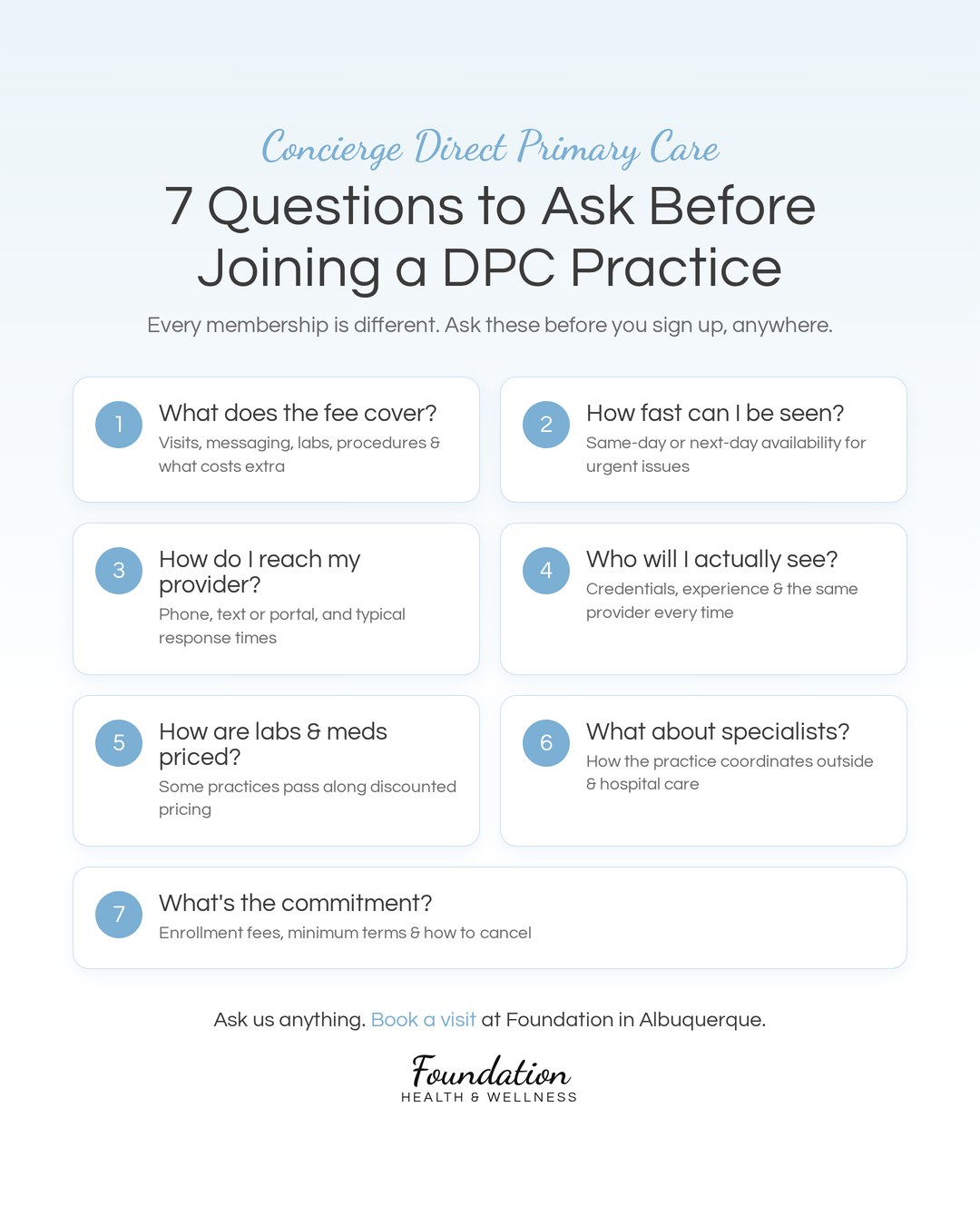
Whether you’ve been searching “direct primary care near me” or you’re already considering Foundation Health & Wellness, these seven questions will help you choose with confidence:
- What exactly does the membership fee cover? Visits, messaging, labs, procedures, and anything that costs extra.
- How quickly can I be seen? Ask about same-day or next-day availability for urgent issues.
- How do I reach my provider, and how fast will I hear back? Phone, text and portal response times matter.
- Who will I actually see? Ask about the provider’s credentials, experience and whether you’ll see the same person every time.
- How are labs and medications priced? Some practices pass along wholesale pricing, and some don’t.
- What happens if I need a specialist or hospital care? A good practice coordinates your care even when it happens elsewhere.
- What’s the commitment? Ask about enrollment fees, minimum terms and how to cancel.
How Does Concierge Direct Primary Care Work at Foundation Health & Wellness?
Our Concierge Direct Primary Care model was designed for people who are ready for a healthcare experience built around their needs, not the system’s constraints. Instead of dealing with insurance restrictions, you pay a predictable monthly fee for unlimited access to your provider, longer appointments and a focus on preventive and root-cause care.
Your care is led by Jalayne Faulhaber, CNP, MEP-C, a certified family nurse practitioner with more than 20 years of experience in emergency care, along with experience in urgent care, primary care, concierge medicine, weight loss and hormone therapy. Because primary care at Foundation lives under the same roof as our other services, your provider can look at the whole picture. That includes energy, sleep, weight, hormones, metabolic health and stress, so concerns don’t get split across multiple clinics that never talk to each other.
Getting started is simple:
- Book an appointment. Schedule online or call (505) 275-4770.
- Receive personalized, root-cause care. We take the time to listen and build a plan around your goals and lifestyle.
- Experience vibrant health and confidence. Gain a trusted partner who knows you and supports you over time.
Learn more on our Concierge Direct Primary Care page. If your main concern is hormones, you can also explore hormone replacement therapy, or read why “your labs are normal” doesn’t always mean you feel normal. If you need to be seen quickly for a sick visit, our urgent care visits are available same-day or next-day.
Frequently Asked Questions About Direct Primary Care
Is direct primary care the same as health insurance?
No. A DPC membership covers primary care services defined in your agreement. It does not cover emergencies, hospital stays, surgery or most specialist care, so most members keep some form of insurance for those.
Do I need insurance to join Foundation’s Concierge Direct Primary Care?
No. Foundation Health & Wellness does not accept or bill insurance. Many members keep separate coverage for major or unexpected medical events, which we recommend considering.
Do I need a referral to join?
No. You can book directly; there are no referrals or prior authorizations needed to get started.
What’s the difference between direct primary care and urgent care?
Urgent care treats a single, immediate problem. Direct primary care is an ongoing relationship that covers prevention, chronic concerns and sick visits with a provider who knows you. If you have a medical emergency, such as chest pain, stroke symptoms or severe bleeding, call 911 or go to the nearest emergency room.
Is direct primary care worth it?
It depends on how you use healthcare, your insurance situation and what you value. If you want more time, faster access and a consistent provider, and you’d use primary care regularly, flat-fee care is often worth comparing against your current total costs.
Ready for Primary Care That Actually Has Time for You?
You deserve a provider who listens, a plan that fits your life, and care that isn’t shaped by insurance quotas. If you’re exploring direct primary care in Albuquerque or comparing concierge primary care in Albuquerque, we’d love to talk about whether our Concierge Direct Primary Care membership is the right fit for you.
>Book Now or call (505) 275-4770. Foundation Health & Wellness, 4550 Eubank Blvd NE, Suite 105, Albuquerque, NM 87111.
This article is for general educational purposes and isn’t medical advice. Talk with your provider about your health needs.